Lists, Stacks and Queues
Objectives:
-
to define the list, stack and queue ADT's
-
to present different data structures for implementing those ADT's
-
to analyze and compare the data structures presented
Lists
-
a list is a finite, ordered sequence of data items
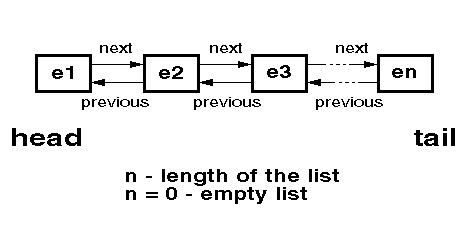
-
ordered list: ei<=ei+1 for all i between 1 and n-1 ("<=" is an ordering
relation over the set of possible elements)
The List ADT
Type: a collection of lists
Operations:
return(k,(e1,e2,...,ek,...,en))=ek
insert(x,k,(e1,e2,...,ek-1,ek,...,en))=(e1,e2,...,ek-1,x,ek,...,en)
remove(k,(e1,e2,...,ek,...,en))=(e1,e2,...,ek-1,ek+1,...,en)
find(x,(e1,e2,...,ek-1,x,ek+1,...,en))=k (k - first occurrence)
find(x,(e1,e2,...,en))=0 (x - not in the list)
Array-Based Implementation
-
list is stored in an array
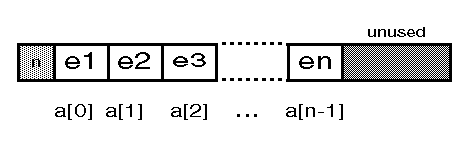
-
length: simply returns n
-
return element: returns a[k-1]
-
insert element: needs to shift n-k elements one to the right
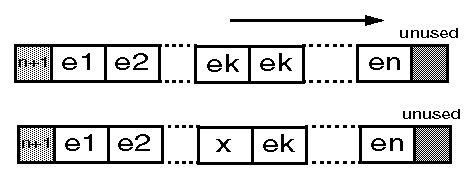
-
remove element: needs to shift n-k elements one to the left
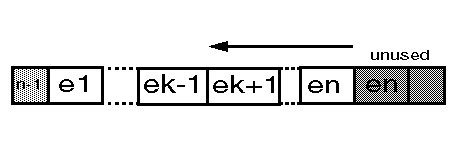
-
find element: visit the elements by incrementing index
i := 0
while (x <> a[i])
i := i +1
return i;
C++ class definition
class List{
private:
int max_size;
int actual_size;
Element* list_array;
public:
List(const int);
~List();
length();
Element& return_nth(const
int);
void insert(const Element&,
const int);
void remove(const int);
int find(const Element&);
};
List::List(const int size){
max_size = size;
actual_size = 0;
list_array = new Element[size];
return;
}
List::~List(){
delete []list_array;
return;
}
int List::length(){
return actual_size;
}
Element& List::return_nth(const int k){
return list_array[k];
}
void List::insert(const Element& e,const int k){
register int k_new;
if (actual_size == max_size)
return;
else{
actual_size++;
k_new = (k < 0) ?
0 : k;
for (int i = actual_size-1
; i > k ; i--)
list_array[i] = list_array[i-1];
list_array[k] = e;
return;
}
}
void List::remove(const int k){
if (actual_size == 0)
return;
else{
actual_size--;
for (int i = k ; i <
actual_size - 1 ; i++)
list_array[i] = list_array[i+1];
return;
}
}
int List::find(const Element& e){
register int i;
for (i = 0; (i<actual_size)&&(list_array[i]
!= e); i++);
if (list_array[i] == e)
return
i;
else
return
-1;
}
Linked Lists
-
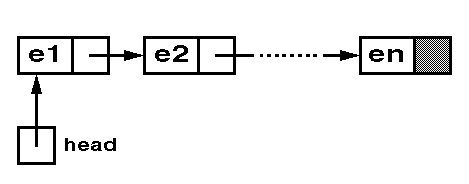
each element is stored in a separate structure (node); the ordering relation
is implemented through pointers
-
length: can be stored in a separate field, otherwise needs to be counted
-
return element: element k is accessed by following the links starting from
the head
-
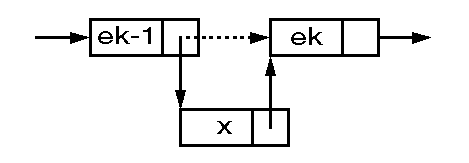
insert element: after accessing the kth element, a new node needs to be
created and the links changed
-
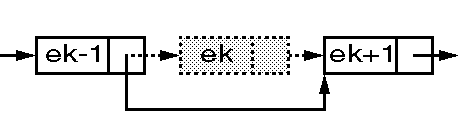
remove element: the node corresponding to the element needs to be freed
and the links changed
-
find element: visit the elements by following the links, starting from
the head (counting in parallel)
current := head
i := 1
while (current.value <> x)
current := current.next
i := i + 1
end (while)
return i;
C++ class definition
class Node{
public:
Element value;
Node *next;
Node(const Element& e, Node* l = NULL)
{value = e; next = l;}
~Node() {};
};
class List{
private:
int actual_size;
Node* head;
public:
List();
~List();
length();
Element& return_nth(const int);
void insert(const Element&, const int);
void remove(const int);
int find(const Element&);
};
List::List(){
actual_size = 0;
head = NULL;
return;
}
List::~List(){
for (Node *current = head; head
!= NULL; delete current)
head =
head -> next;
return;
}
int List::length(){
return actual_size;
}
Element& List::return_nth(const int k){
Node* current = head;
for (int i = 0 ; i != k ; i++)
current
= current -> next;
return current-> value;
}
void List::insert(const Element& e,const int k){
Node* current = head;
actual_size++;
if (k <= 0){
head = new Node(e,head);
return;
}
else{
for (int i = 1 ;(i<k) &&
current->next!=NULL); i++)
current
= current->next;
current->next = new Node(e,current->next);
eturn;
}
}
void List::remove(const int k){
Node* current = head;
Node* temp;
if ((k < 0) || (actual_size
<= k))
return;
else{
actual_size--;
if (k
== 0){
temp = head;
head = head->next;
}
else{
for (int i = 1 ; i < k ; i++)
current = current->next;
temp = current->next;
current->next = (current->next)->next;
}
}
delete temp;
return;
}
int List::find(const Element& e){
Node* current = head;
register int i;
for(i=0;(current->value!=e)&&(current->next!=NULL);i++)
current = current->next;
if (current->value == e)
return i;
else
return -1;
}
Comparison of list implementations
-
the size of an array-based list has to be predetermined
-
a linked list only needs space for the elements actually on it
-
array-based lists don't require extra space for each element
-
linked lists required that a pointer be added to each element
From the point of view of space required array-based
lists are better when the size of the list is approximately known in advance
-
elements in an array-based list can be accessed fast by indexing
-
accessing an element in a linked list requires visiting the elements preceding
it
-
inserting and removing an element for an array-based list requires shifting
part of the array
-
inserting and removing an element for a linked list requires a fixed number
of operations
Linked lists are preferred to array- based lists from
the point of view of time required
Implementing elements
-
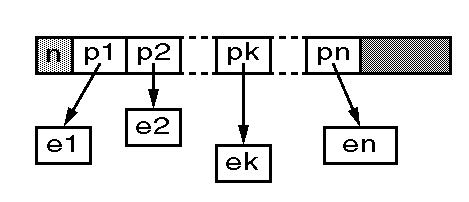
for lists with large elements (such as strings or structures) storing pointers
to the elements may be useful
-
this is advantageous when a certain element is repeated in the list (e.g.
strings)
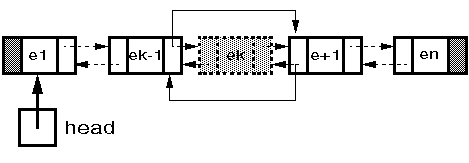
Doubly linked lists
-
linked lists only allow the direct access from a node to the next node
-
the insertion and deletion of elements in a linked list are complicated

Stacks
A stack is a list in which elements may be inserted or
removed from only one end.
-
operations on stacks have special names:
pop for access & remove
-
stacks can be implemented both as arrays and as linked lists
Queues
A queue is a list in which an element may only be inserted
at the end and may only be accessed and removed at the head
-
operations on queues have special names:
dequeue for access & remove
-
queues can be implemented both as arrays and as lists
-
the array-based queue implementation raises special problems (drifting
queue)