Algorithm Analysis
-
to present ways to measure the
efficiency of an algorithm
-
to define the concept of growth
rate of the cost of an algorithm depending on the growth of the problem
size
-
to define the notions of lower
bound and upper bound for a growth rate
-
review some mathematical tools
needed for algorithm analysis
Measuring Algorithm Efficiency
Purpose:
-
to estimate the resources needed
by an algorithm
-
to choose from several algorithm
solving the same problem
Efficiency has
to do with the use of resources.
Resources used
by an algorithm:
-
time
-
storage
-
effort required to code ...
We will concentrate
on time efficiency:
The amount of
time required by an algorithm
Ways to measure time efficiency
-
Implement the algorithm and run
it on a computer
depends on machine!
-
Sum up the times required by all
the commands used to the algorithm has to perform
depends on implementation!
-
Count only the specific (basic)
operations performed by the algorithm
Example:
int largest (int*
array, int n){
int currlarge = 0;
for (int i=0 ; i<n ; i++)
if (array[i] > currlarge)
currlarge = array [i];
return currlarge;
}
Note. This program
only works if at least one element of the array is greater or equal than
0.
-
the basic operation is the comparison "array[i] > currlarge"
because it is the operation that is absolutely needed to solve this problem
The basic operation is usually selected
to be the operation that:
-
is needed to solve the problem
-
is the most time consuming
-
is the most frequently used
The time required
by an algorithm usually depends on the "size" of the problem instance it
is presented with:
-
it usually grows with the growth
of the growth of the problem size
We need to study
this dependency!
Problem size: depends on the number of symbols needed
to describe it.
-
an instance of the maximum search
problem is described by the elements of the array
-
since there are n elements the
description of an instance of this problem requires n times the number
of symbols needed to describe an element
We will specify
this dependency as a function defined over the problem sizes which gives
the number of basic operation for each problem size
Best, Worst and Average Cases
Worst case:
-
an upper bound on the number of
basic operations that will be performed
Best case:
-
a lower bound on the number of
basic operations that will be performed
Average case:
-
the average number of basic operations
that will be performed over all the problems of a given size
Example:
Consider the
following program for searching for a given number in an array of size
n (assumes that the element is in the array!):
int search(int* array, int n, int x){
int i = 0;
while (array[i]
!= x)
i++;
return i;
}
Worst case:
happens when x is in the last position - fb(n)=n
Best case: happens
when x is in the first position - fw(n)=1
Average case: 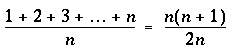
Calculating the Running Time
-
sequences: the running time for
a sequence of statements is the sum of the running times for each of the
statements
-
loops: the running time for a
loop is the sum over all the iterations of the running times of the body
for those iterations
-
binary decisions: the worst(best)-case
running time for a binary decision is the maximum(minimum) between the
running times for its two branches
-
recursion: the running time for
a recursive program is given by a recursion
Examples:
-
x = a+b*(c+d);
y = (x+2*a*b)/3;
...
-
sum = 0;
for(i=1; i<=n ; i++)
sum += n;
...
-
sum = 0;
for(j=1; j<=n ; j++)
for(i=1; i<=n ; i++)
sum++;
...
-
sum = 0;
if(n%2)
for (i=1 ; i<=n ;
i++)
sum += i;
else
for (i=2 ; i<= n
; i+=2)
sum += i;
...
-
int Bsearch(int* array, int n, int x){
if (n == 1)
return array[0] == x;
else
k = n/2;
if (array[k]<x)
return Bsearch(&array[0],k,x);
else
return Bsearch(&array(k),k,x);
}
How do we compare two algorithms based on their running
time expressed as a function of the problem size?
This reduces
to the problem: How do we compare two functions?
Assume that
the problem size is characterized by a non-negative integer n.
Definition
1. The running time T(n) of an algorithm is O(f(n)) if there exist
the positive constants c and n0 such that  for all n>n0.
Definition
2. The running time T(n) of an algorithm is  (f(n)) if there exist the positive constants c and n0 such that
for all n>n0.
Definition
3. The running time T(n) of an algorithm is  (f(n)) if T(n) is both O(f(n)) and
  (f(n)).
