
To print this article open the file menu and choose Print.
Click here to return to previous page
Article published May 23, 2005
‘Assistment’ makes grade
Program by WPI prof coaches students for MCAS
By Jacqueline Reis TELEGRAM & GAZETTE STAFF
jreis@telegram.com
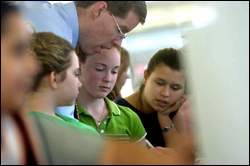
Worcester Polytechnic Institute professor Neil T. Heffernan talks to Forest Grove Middle School student Elaine R. Borenstein, center, during a computer instructional math program to help students prepare for the MCAS tests. (T&G Staff / TOM RETTIG)
WORCESTER Approximately 1,000 eighth-graders at three of the city’s middle schools had extra help preparing for last week’s math MCAS tests.
Once every two weeks this school year, they went to a computer lab and answered practice questions using a program being tested by a Worcester Polytechnic Institute professor.
The program does more than spit out questions to be learned by trial and error. When a pupil gets an answer wrong, a message appears that says, “Hmm, no. Let me break this down for you.” Hints from the computer reduce the problem to three to five steps and ask the student to fill in boxes along the way until he or she arrives at the answer.
Neil T. Heffernan, an assistant professor of computer science at WPI, is in the second year of a four-year, $1.4 million federal grant to test the program, which he calls an “assistment” system, because it assists students and assesses them simultaneously. He is one of four principal investigators for the project; the others are Kenneth R. Koedinger and Brian Junker of Carnegie Mellon University, where Mr. Heffernan received his doctorate; and Steven Ritter of Carnegie Learning Inc., a Pennsylvania-based company that develops math curricula.
Pupils at Forest Grove, Worcester East and Burncoat Middle schools participated this year, and Mr. Heffernan hopes to expand eighth-grade participation and start developing a 10th-grade program next year. He taught eighth-grade math for two years before getting his doctorate, and he hopes to keep expanding the program’s reach. “I want every student in the state of Massachusetts to have this for free,” he said.
Local teachers have helped write the steps that coach students to a correct answer. “Neil has a college mind, and I have an eighth-grade mind, so what we did is I helped word the hint questions down to an eighth-grade level,” said Forest Grove Middle School math teacher and department head Paul H. King. Even with 13 years of teaching behind him, the program has helped him target his instruction better and helped him prepare a review for the week before the MCAS.
It’s far more immediate feedback than the school gets from MCAS scores, which typically come out the autumn after students take them. “The MCAS data we have is fine, but it’s on kids that we no longer have,” said Donald W. Kelley Jr., quadrant manager for the North and Doherty quadrants, which include Forest Grove. “This kind of a tool helps immensely, because you can really target the students.”
Pupils said they enjoyed how the program tailors itself to them and lets them move at their own pace. “It lets you learn your weaknesses,” said Zaire Harding. “I can see I’m improving.”
Sometimes the program’s hints fall short of the mark, so pupils work it out with a friend or turn to an adult. “The computer doesn’t know exactly what you’re thinking if you don’t get it,” said pupil Haley K. O’Connor. In those cases, it helps to have Mr. Heffernan and his college students on hand.
In addition to helping pupils on the test, the program tracks their responses, notes who has problems on which questions, and compares how well each class does on each question compared to other classes and the city as a whole. It also predicts a student’s score on the MCAS. Because the tool is Web-based, teachers can access their class’ results from home. In theory, students could also use it from home in the future, Mr. Heffernan said.
Copyright 2005 Worcester Telegram & Gazette Corp.